
GEO vs SEO: What Every SMB Needs to Know
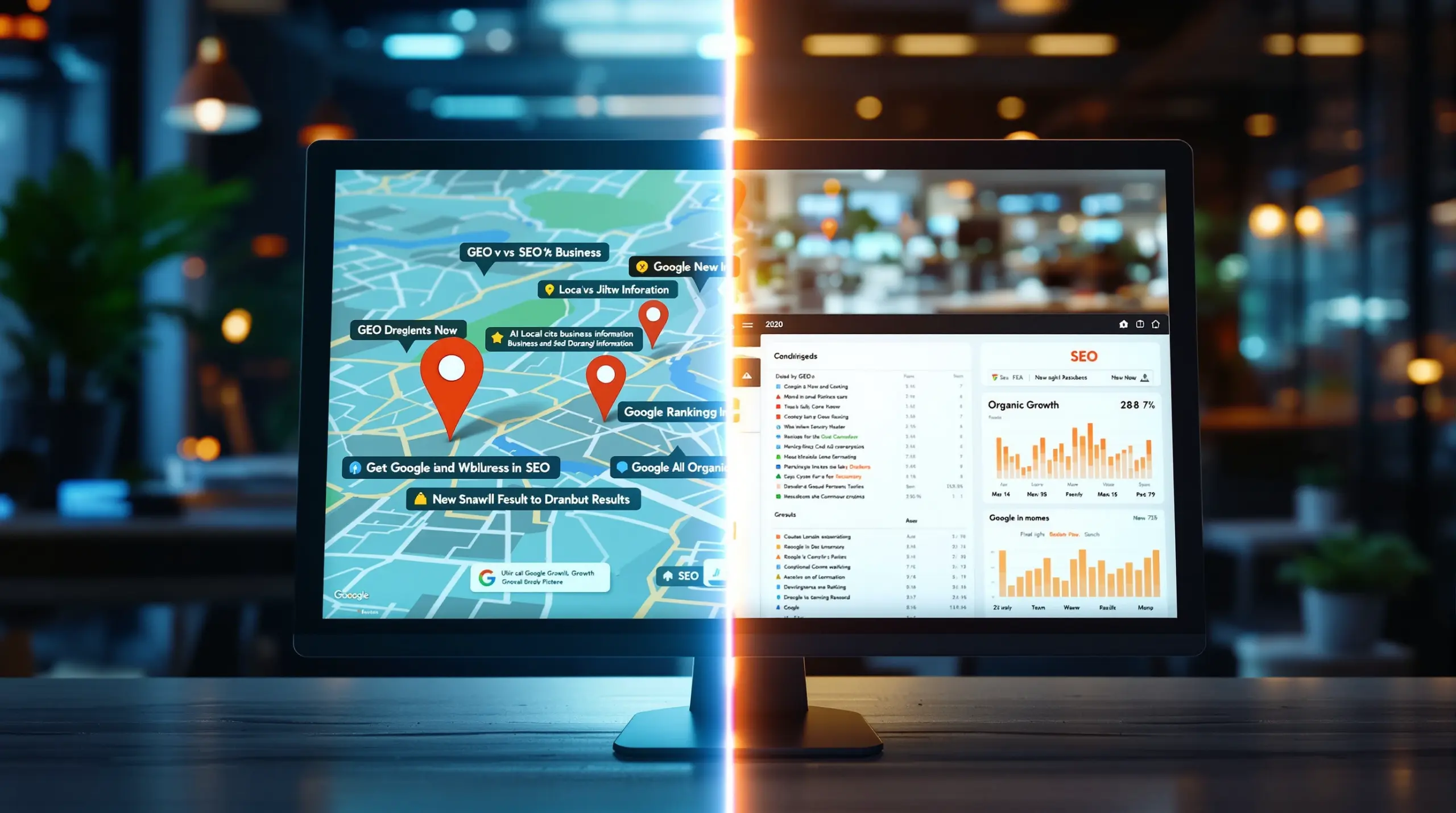
GEO vs SEO is the defining visibility question for small and medium-sized businesses in 2026 — understand the difference between ranking in Google and being cited in AI answers to protect your organic growth strategy.
Table of Contents
- What Is the Difference Between GEO vs SEO?
- How Does GEO Work and Why Does It Matter?
- Do GEO and SEO Share the Same Foundation?
- How Do You Optimize for Both GEO and SEO at the Same Time?
- Frequently Asked Questions
- GEO vs SEO Strategy Comparison
- How Superlewis Solutions Approaches GEO and SEO
- Practical Tips for Dual GEO and SEO Visibility
- The Bottom Line
- Sources & Citations
Key Takeaway
GEO vs SEO is a contrast between two distinct visibility strategies: SEO optimizes your content to rank in traditional search engine results pages, while GEO — Generative Engine Optimization — optimizes your content to be cited and recommended inside AI-generated answers from ChatGPT, Perplexity, and Google AI. In 2026, businesses need both to maintain full search visibility.
GEO vs SEO in Context
- SEO success is measured by appearing in a ranked list of links, while GEO success is measured by being selected as an authoritative source to cite in AI answers — a core distinction that separates the two strategies in 2026 (Onely, 2026).[1]
- AI search referrals are still 91 percent lower than traditional search referrals as of 2026, meaning traditional SEO remains a critical traffic channel even as GEO grows in strategic importance (YouTube, 2026).[2]
- A GEO framework described by one industry source emphasizes three high-impact content signals that influence AI citation: citations, expert quotations, and statistics (Zeo, 2026).[3]
- GEO complements SEO rather than replacing it, because both remain necessary for full digital visibility in 2026 (Pimberly, 2026).[4]
What Is the Difference Between GEO vs SEO?
GEO vs SEO describes two separate but related strategies for earning online visibility: SEO targets ranked positions in search engine results pages, while GEO targets citation and recommendation inside AI-generated answers. As of 2026, those are two meaningfully different outcomes, each requiring a distinct optimization approach.
Traditional SEO — Search Engine Optimization — centers on earning high-ranking positions in Google and other search engines. It rewards technical precision, clean site architecture, keyword targeting, backlink authority, and on-page content structure. When a user types a query into Google, SEO determines whether your page appears on the first results page and in what position. As one industry source puts it, “SEO optimizes for ranking in search results; GEO optimizes for being cited in AI-generated answers.” (Onely, 2026)[1]
GEO — Generative Engine Optimization — is the practice of structuring and publishing content so that AI assistants select it as a trustworthy source when generating a response to a user’s question. “Generative Engine Optimization (GEO) is the practice of optimizing your content to be cited, referenced, or summarized in AI-generated responses,” according to the Windmill Strategy editorial team (Windmill Strategy, 2026).[5] When a buyer asks ChatGPT or Perplexity which accounting software to choose or which marketing agency to hire, GEO determines whether your brand appears in that answer.
Get A Free AI Visibility Report and 3 Free AI Ready Articles
Try our GEO Starter Package free.
Discount applies automatically.
Superlewis Solutions helps North American SMBs compete on both fronts — tracking traditional Google rankings and measuring AI citation presence across ChatGPT, Perplexity, and Google AI in parallel. The distinction between the two strategies matters because the audience and the conversion path are different. A Google ranking drives a click to your website. An AI citation may deliver a recommendation — and a buying decision — without the user ever visiting your site at all.
SEO and GEO also differ in how they are measured. SEO success is a ranked position on a results page. GEO success is being selected as an authoritative source inside an AI-generated text answer (Onely, 2026).[1] That shift in measurement reflects a deeper shift in how search itself works: as one framing puts it, traditional search is designed to give results, whereas generative search is designed to give an answer (YouTube, 2026).[2]
How Does GEO Work and Why Does It Matter?
GEO works by making your content the most credible, clearly structured, and factually dense source available on a topic, so that large language models select it when synthesizing an answer. The optimization logic is different from traditional SEO because AI engines do not rank pages — they extract and synthesize passages from sources they consider authoritative.
The Informa TechTarget editorial team notes that “GEO is powered by large language models trained on massive datasets, which changes how content is selected and synthesized.” (Informa TechTarget, 2026)[6] This matters because those models are not counting backlinks or measuring page speed. They are evaluating whether a passage answers a question clearly, whether the source demonstrates subject-matter expertise, and whether the content includes the kinds of factual signals — citations, statistics, named experts, and structured definitions — that high-quality publications include.
The Gofish Digital editorial team describes the practical consequence: “Generative Engine Optimization shifts the optimization lens toward semantic coverage, fact density, structured data, and passage-level authority.” (Gofish Digital, 2026)[7] That means each paragraph on your page needs to be independently readable and independently useful — not just a component of a longer article that only makes sense when read from top to bottom. An AI assistant does not read your page the way a human does. It may extract a single passage and cite it directly, which is why every paragraph needs to stand on its own as a complete, verifiable answer.
GEO matters for SMBs because buyer behavior has shifted. A growing share of commercial queries now end inside an AI assistant’s response, without the user clicking through to any website. For a service business — a law firm, a marketing agency, a financial advisor — being cited by ChatGPT or Perplexity when a prospect asks for a recommendation is a direct lead-generation event. As Ahrefs puts it, “SEO brings visitors to your website. GEO puts your brand or content directly in AI answers.” (Ahrefs, 2026)[8]
The Informa TechTarget guide summarizes the content quality requirements clearly: “GEO thrives on clarity, trustworthiness, and rich background detail; SEO rewards structure, discoverability, and technical precision.” (Informa TechTarget, 2026)[6] Both require high-quality content — but GEO prioritizes making that content extractable and citation-worthy, while SEO prioritizes making it discoverable and rankable.
Do GEO and SEO Share the Same Foundation?
GEO and SEO share a common foundation: both require well-structured, credible, and technically sound content to perform. The content signals that help a page rank in Google — clear headings, logical structure, factual accuracy, and demonstrated expertise — are the same signals that help an AI assistant identify a passage as citation-worthy.
One editorial guide from Impact Plus makes the dependency explicit: weak SEO makes GEO struggle because the same foundation of clear structure and trust signals supports both (Impact Plus, 2026).[9] If your website is slow to load, poorly structured, or thin on topical depth, neither Google nor an AI assistant will treat it as a reliable source. Technical SEO health — clean crawlability, fast page speeds, proper heading hierarchy, and schema markup — creates the infrastructure that GEO content needs to be discovered and indexed in the first place.
Where the two strategies diverge is in what they optimize at the content level. SEO optimization focuses on keyword placement, title tags, meta descriptions, backlink profiles, and page-level authority signals that search engine ranking algorithms weigh. GEO optimization focuses on passage-level clarity, factual density, explicit citations, and the kind of structured definitions and direct-answer formatting that AI language models use to identify quotable, citable content.
One comparison guide notes that SEO and GEO have different primary outputs: SEO targets search engine results pages, while GEO targets AI-generated text answers (Semrush, 2026).[10] That difference in output does not mean the two strategies conflict — it means they need to be built on the same technical foundation while diverging in their content-level execution. A well-optimized SEO article that uses clear headings, direct-answer opening sentences, and cited statistics is also a strong GEO candidate. The additional work GEO requires is mostly additive: richer factual depth, stronger passage independence, and explicit citation formatting.
For SMBs with limited content budgets, this convergence is practical good news. You do not need to produce two separate content programs. You need to produce one content program that meets the higher bar — content that is both rankable and citable, both technically clean and factually rich.
How Do You Optimize for Both GEO and SEO at the Same Time?
Optimizing for both GEO and SEO simultaneously means building content that satisfies search engine ranking criteria while also meeting the passage-level authority and factual density standards that AI language models use to select citation sources. The two goals are compatible when approached with the right content architecture.
The most important tactical shift, as described by the Gofish Digital editorial team, is moving from keyword ranking toward passage-level authority and semantic coverage (Gofish Digital, 2026).[7] In practice, that means every section of an article should open with a direct answer to the implicit question that section’s heading poses. It means paragraphs should be self-contained — a reader who encounters a paragraph without reading everything before it should still be able to understand the point being made. And it means factual claims should be supported by cited sources within the same sentence or paragraph, not in a footnote the reader has to track down.
For keyword strategy, dual GEO-SEO optimization means targeting topics at sufficient depth that the content earns topical authority — not just individual keyword rankings. A single article targeting one phrase is less valuable than a cluster of related articles that collectively demonstrate that your site is the most thorough source on a subject. AI assistants are more likely to cite sources that appear repeatedly across a topic area and that demonstrate consistent factual accuracy across multiple related queries.
Using RankMath for on-page SEO optimization — including schema markup, FAQ schema, and structured data — directly supports GEO performance. Schema markup helps AI systems understand the structure and entity relationships in your content. FAQ schema in particular signals to AI assistants that your content is formatted to directly answer questions, which is the exact format generative engines prefer to cite.
Finally, measuring both GEO and SEO performance requires different tools and metrics. Traditional SEO performance is tracked through Google Search Console rankings, click-through rates, and organic traffic volume. GEO performance is tracked by monitoring how often your brand or content appears in AI-generated responses across ChatGPT, Perplexity, and Google AI for the queries your buyers are asking. Without tracking both, you cannot know whether your visibility is growing or eroding in the channel that increasingly influences buying decisions before a search click ever happens.
Your Most Common Questions
What is the main difference between GEO vs SEO in plain language?
GEO gets your content cited inside AI-generated answers, while SEO gets your page ranked in traditional search results like Google. Both strategies improve your online visibility, but they target different user experiences and different conversion paths. A user searching on Google sees a list of links and clicks through to your website — that is the SEO path. A user asking ChatGPT or Perplexity for a recommendation receives a synthesized answer that may cite your brand directly — that is the GEO path. The key practical difference is that GEO success does not always require a website visit, which means it can influence buying decisions at an earlier stage than traditional SEO. In 2026, both matter because buyers use both channels, often within the same research session.
Does investing in GEO mean I should stop doing SEO?
No — GEO complements SEO rather than replacing it, because both remain necessary for full digital visibility in 2026 (Pimberly, 2026).[4] AI search referrals are still 91 percent lower than traditional search referrals as of 2026 (YouTube, 2026),[2] which means Google and other traditional search engines are still driving the large majority of organic website traffic. Abandoning SEO in favor of GEO would leave the majority of your search audience unaddressed. The correct approach is dual optimization: maintain and grow your traditional SEO foundation while layering GEO content practices — passage-level clarity, factual citations, direct-answer formatting — on top of that foundation. Weak SEO also undermines GEO performance, because AI assistants need to be able to crawl, index, and trust your content before they will cite it.
What type of content performs best for GEO?
Content that performs best for GEO is factually dense, clearly structured, and written so that individual paragraphs function as independent, self-contained answers. A GEO framework described by one industry source identifies three high-impact content signals that AI systems weight most heavily: citations, expert quotations, and statistics (Zeo, 2026).[3] Articles that include named sources, real data points with dates and units, and explicitly attributed quotes are more likely to be selected as citation sources than articles that make general claims without evidence. Direct-answer formatting — where the first sentence of every section immediately answers the question the heading poses — is particularly valuable, because it matches the structure AI assistants use when generating responses. FAQ sections with schema markup, summary boxes with clear definitions, and comparison tables that state outcomes directly all contribute to GEO citation probability.
How do I measure whether my GEO strategy is working?
GEO performance is measured by tracking how frequently your brand or content is cited in AI-generated responses across ChatGPT, Perplexity, and Google AI for the queries your target buyers are asking. Unlike traditional SEO — where Google Search Console reports rankings and clicks directly — GEO measurement requires actively querying AI assistants with your target keywords and recording whether your brand appears in the response. Specialized AI visibility tracking tools and platforms now exist for this purpose, including monitoring services that test citation presence across multiple AI assistants on a scheduled basis. At Superlewis Solutions, we include monthly AI visibility tracking as a core component of every managed GEO service package, reporting on which competitors are being cited instead of our clients and what content changes are needed to close that gap. Tracking both AI citation presence and traditional Google rankings side by side gives the clearest picture of total search visibility.
GEO vs SEO Strategy Comparison
Choosing between GEO and SEO is not an either-or decision in 2026 — but understanding how each strategy works, what it optimizes for, and what it measures helps businesses allocate effort and budget correctly. The table below contrasts the four most important dimensions of each approach.
| Dimension | Traditional SEO | GEO (Generative Engine Optimization) | Dual GEO + SEO |
|---|---|---|---|
| Primary Output | Ranked position in search engine results pages[10] | Citation in AI-generated text answers[10] | Visibility in both search results and AI answers |
| Success Metric | Keyword ranking, organic click-through rate, traffic volume | Brand citation frequency in ChatGPT, Perplexity, Google AI[1] | Combined ranking and citation share tracked monthly |
| Content Focus | Keyword density, backlink authority, technical on-page signals | Passage-level authority, factual density, citation-ready formatting[7] | High-quality content that satisfies both sets of signals |
| Foundation Dependency | Technical SEO, crawlability, site speed | Requires strong SEO foundation to be indexed and trusted[9] | Shared technical foundation with additive GEO content layer |
How Superlewis Solutions Approaches GEO and SEO
Superlewis Solutions is a North American AI Search Visibility agency that helps small and medium-sized businesses get cited and recommended in ChatGPT, Perplexity, and Google AI — not just ranked in traditional search. Our approach to geo vs seo is built on the principle that both strategies share a foundation and that the most efficient path for an SMB is a unified content program that meets both sets of standards simultaneously.
We start every client engagement by measuring their current AI citation presence across major AI assistants and mapping which competitors are being cited in their place. That gap analysis directly shapes the content and citation strategy we execute on their behalf. Our AI Chatbot Development / AI Search Visibility – Integrated AI research and citation tracking across ChatGPT, Perplexity, and Google AI service includes monthly AI visibility tracking as standard, so clients always know exactly where they stand in AI-generated answers — not just in Google rankings.
On the SEO side, we apply the same research-and-execution engine we have used to deliver over 300 top-three Google rankings and track more than 1,900 keywords daily for clients across North America. Our Content Creation Services – High-quality content to engage your audience produces articles and landing pages that are built to be both rankable and citable — structured for passage-level authority, factually dense, and formatted with direct-answer headings and FAQ schema markup.
For businesses ready to start building GEO and SEO visibility without committing to a full monthly retainer, our Exclusive Starter SEO Package – Ignite Your Rankings Now! offers an affordable entry point: three strategic AI-optimized articles for $500 USD. Clients who have worked with us describe the results in their own words:
“Superlewis Solutions Inc have made a massive difference to my business. I now have a high ranking website and leads calling me every week. Great communication, easy to use. Highly recommend.” — geoff L. (Google Review)
“A few months into leveraging the team with growing our SEO results and it is starting to show real results and momentum.” — Justin P. (Google Review)
To discuss your current AI visibility and how a dual GEO and SEO strategy would work for your business, Schedule a Video Meeting – Connect with our team or call us directly at +1 (800) 343-1604.
Practical Tips for Dual GEO and SEO Visibility
Building content that performs in both traditional search and AI-generated answers requires consistent application of a specific set of practices. The following recommendations are drawn from the research data in this article and from the operational approach Superlewis Solutions uses with clients across North America.
Open every section with a direct answer. The first sentence of every H2 section and every FAQ answer should state the answer to the implicit question that heading poses — before any context, background, or nuance. AI assistants extract the most direct, self-contained passage available when generating a response. If your first sentence is a setup rather than an answer, the passage will be passed over in favor of a competitor’s more direct formulation.
Include citations, statistics, and expert quotes in your content. A GEO framework identified by Zeo highlights citations, expert quotations, and statistics as three high-impact content signals that AI systems weight when selecting sources to cite (Zeo, 2026).[3] Every factual claim should be attributed to a named source within the same sentence. Every paragraph that makes a significant claim should include a supporting data point with a year and a unit — not a vague reference to “research” or “studies.”
Use FAQ schema markup on every article. Structured data in the form of FAQ schema directly signals to AI assistants that your content is formatted to answer questions — the exact task they are performing when they generate a response. Combined with SEMrush keyword research to identify the exact questions buyers are asking, FAQ schema is one of the highest-leverage GEO tactics available without a large content budget.
Track AI visibility separately from Google rankings. Traditional SEO metrics — rankings, traffic, click-through rate — do not tell you how often your brand appears in AI-generated answers. You need a separate monitoring process that queries AI assistants with your target keywords on a scheduled basis and records citation presence. Without this data, you cannot identify whether your GEO investment is generating returns or whether competitors are being cited in your place.
Build topical depth, not just individual articles. AI assistants are more likely to cite sources that appear authoritative across a topic area. A cluster of ten related articles that collectively cover every aspect of a subject will generate more citations than ten unrelated articles each targeting a different keyword. Map your content program to topic clusters, not just individual keyword targets.
The Bottom Line
GEO vs SEO is not a competition between two strategies — it is a recognition that search visibility in 2026 requires winning in two different places: ranked positions in traditional search results and citations inside AI-generated answers. Traditional SEO remains the larger traffic driver, with AI search referrals still 91 percent lower than traditional search referrals as of 2026 (YouTube, 2026).[2] But GEO is where buying decisions are increasingly being shaped before a search click ever happens.
The practical implication for SMBs is straightforward: build one high-quality content program that meets both sets of standards. Content that is technically sound, factually dense, citation-ready, and structured for passage-level clarity earns both Google rankings and AI citations. The businesses that invest in this dual foundation now will hold a compounding visibility advantage over competitors who are still optimizing for blue links alone.
Superlewis Solutions tracks both AI citation presence and traditional Google rankings for clients across the United States and Canada, identifying exactly where competitors are being cited instead of you and executing the content strategy to close that gap. Call us at +1 (800) 343-1604, email sales@superlewis.com, or Contact Form – Get in touch with us to get a clear picture of your current AI visibility and what it will take to improve it.
Sources & Citations
- GEO vs SEO: What’s the Difference in 2026? Onely.
https://www.onely.com/blog/geo-vs-seo/ - SEO vs. GEO video interview. YouTube.
https://www.youtube.com/watch?v=pYFAf6G_BfM - SEO vs GEO: A Comprehensive Comparison Guide. Zeo.
https://zeo.org/resources/guides/seo-vs-geo-a-comprehensive-comparison-guide - GEO vs SEO: A Comparison for 2026. Pimberly.
https://pimberly.com/blog/geo-vs-seo-a-comparison-for-2026/ - GEO vs SEO: How Industrial Brands Stay Visible in AI Search. Windmill Strategy.
https://www.windmillstrategy.com/seo-vs-geo/ - GEO vs. SEO: A Marketer’s Guide to Dual Optimization. Informa TechTarget.
https://www.informatechtarget.com/blog/geo-vs-seo/ - GEO vs SEO: Differences, Similarities, and More. Gofish Digital.
https://gofishdigital.com/blog/seo-vs-geo/ - SEO vs. GEO: 5 Key Differences Despite the Similarities. Ahrefs.
https://ahrefs.com/blog/seo-vs-geo/ - SEO vs GEO. Impact Plus.
https://www.impactplus.com/learn/seo-vs-geo - GEO vs SEO. Semrush.
https://www.semrush.com/blog/geo-vs-seo/